The Java Jive
The Ink Spots' popular 1940s tune about the caffeine-laden cheery bean and its hipster coffee slang lyrics. What the heck are they talking about?

Thanks for reading my Substack! If you enjoy these artists and their work, tune in to my radio show “Golden Age Radio” for more of the same. On Thursday mornings, 9-11 AM EST. You can stream live or listen for up to two weeks after airtime at Wfhb.org. Community radio for south-central Indiana.
I first remember hearing an Ink Spots tune while in grade school Bugs Bunny sang “Someone’s Rocking My Dreamboat” in the Warner Brothers cartoon “Gorilla My Dreams.” I had no idea it was an Ink Spots song. I was too young to know who the Ink Spots were and I didn’t get the cultural references in the 1948 cartoon. That did not keep me from enjoying the cartoon and laughing out loud at Bugs and his sarcastic humor (as only Mel Blanc could deliver it).
Later during my high school years, as I began to discover jazz and pop music, I learned the original Ink Spots were fellow Hoosiers from Indianapolis. They predated my beloved rock and roll and rhythm and blues, but clearly laid the groundwork for these genres. Popluar during the 30s, 40s and 50s, they represented my parents’ generation of music. They had a distinct sound referred to as the “top & bottom” format. A vocal quartet, the high tenor voice would sing the lead for one chorus, followed by a chorus performed by the bass singer who would recite the lyrics rather than sing them. Here is an example of an early colossal Ink Spots hit “If I Didn’t Care.”
Jimmy Holmes - Lead Vocal, Essex Scott - 2nd Tenor Vocal, Charlie Fuqua - Baritone Vocal & Guitar, and Harold Jackson - Bass Vocal from a 1955 Texas television show.
The format of this song was pretty much the format of most of their popular tunes. They all started with a guitar solo riff (I- #idim - ii7 - V7) that set the tempo and the key of the song. It became their songs’ opening blueprint. Then the lead singer (high tenor) would come in and sing a chorus followed by the bass in his best basso profundo who would recite the lyrics in a type of monologue. In many of his recitations he included the terms “honey child” or “honey babe.” Audiences loved it. They were immensely popular among black and white audiences alike and enjoyed international fame.
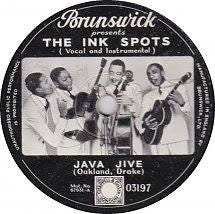
However, one of their most popular tunes did not follow the “top & bottom” format (although it did include that recognizable intro guitar riff). It focused more on the group’s vocal harmonies and skipped the bass vocal recitation completely. “Java Jive”, recorded in 1940, reached #15 on the billboard charts.
It is my very favorite Ink Spots tune.
But what the heck is it about?
Grab a “cup of joe” and listen.
Lyrics here By Milton Drake.
Clearly this song is a celebration of the caffeine in coffee and tea and its pleasant and energizing buzz on the human brain. (Few of us can begin our mornings without it.) “I love the java jive and it loves me…” It is full of metaphor-heavy 1940s hepcat and lunch counter slang which makes this swing tune even more fun.
Some of the slang used is easy to identify, like the term “java” for coffee. The Dutch brought coffee from the Indonesian island of Java in the 1600s (for which we are eternally grateful). “Java” became slang in the U.S. for coffee as early as the late 1800s. By the 1930s, coffee was referred to as a “cup of joe”. Joe was considered a common man’s name, and coffee a common man’s drink. Or perhaps it was the shortening of the term “jamoke”, a combination of the words Java and mocha. Who knows? Historians still scratch their heads about it.
However, there is more “jive” (or slang) in the song which may not be recognizable. The most curious to me is “I love java, sweet and hot / Whoops Mister Moto, I'm a coffee pot!” Wikipedia claims it as a nonsensical rhyming couplet. Maybe, as many songs from this time period had nonsensical words included. (as an example, Milton Drake also penned the lyrics to “Mairzy Doates”) Mr. Moto was a fictional Japanese secret agent (played by Peter Lorre) in some 1930s films. I am clueless what Mr. Moto has to do with coffee, so perhaps Wikipedia is right. However, Moto is also Mexican Spanish slang for marijuana….so there’s that for your consideration!
“Shoot me the pot and I’ll pour me a shot” The song draws metaphors of consuming coffee like alcohol.
“And I’ll cut a rug till I’m snug in a jug” I’ll dance until I am feeling no pain.
“A slice of onion and a raw one/Draw one/Waiter, waiter, percolator” Some possible references to hangover cures?
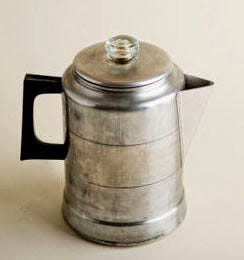
Ordering a ‘slice of onion and a raw one’ was lunch counter slang for a hangover cure (a raw onion and a rare hamburger or egg). “Draw one” means pour me a cup from the coffee urn - coffee was also a hangover cure. And then another nice rhyming line referring to the lunch counter server and his brewing coffee percolator.
The song also mentions several different beans: Boston beans, soy beans, green beans, but ends “I’m not keen about a bean/ unless it is a cheery, cheery bean.” The original words were supposed to be “cheery, beery bean” as a pun on the song "Ciribiribin", but the Ink Spots' lead singer, Deek Watson, inadvertently sang it as "cheery cheery bean." Other covers of the song have generally followed Watson’s lyric or changed it to "chili chili bean."
So go ahead. Pour yourself a shot of joe from your percolator, and cut a rug while listening to “Java Jive.” At least now you will understand some of the lyrics and you can practice your jive talk while you sip.
Further reading:
https://sites.psu.edu/passion2019bodinger/2019/09/18/an-energizing-song/
https://en.wikipedia.org/wiki/Java_Jive
https://en.wikipedia.org/wiki/The_Ink_Spots
https://www.edsullivan.com/celebrating-black-music-month-the-legacy-of-the-ink-spots/
http://www.bluefisheditorial.com/blog/word-of-the-week-zambazo
https://margaret-cooter.blogspot.com/2014/10/poetry-thursday-java-jive-by-inkspots.html
Fascinating stuff as always Kathy. My grandparents had Ink Spots 78s. They were baffling to a five year old. I couldn’t understand that high tenor voice. I thought it was a joke but why were the lyrics serious on some of their songs?
I grew up to appreciate falsettos like Dee Clark.
See you later, percolator!
Fun song, nice to visit the roots. My first listen to Java Jive was through the unique vocal stylings of Manhattan Transfer.